Development Journey — "The Idol That Wakes" (working title: raider-of-lost-art)
Date: 2026-10-04
Deliverable: the film, playable at https://az9713.github.io/raider-of-lost-art/ (file: docs/film.mp4, 36.25 s, 854x480, 24 fps, with generated audio)
Brief: the first message of the session that wrote this document was only the file name @HANDOFF.md. The original brief is reconstructed from that file's "Goal" section: "A 45-second action-thriller short, 16:9, no dialogue, made with the course workflow from the Higgsfield Academy "Blockbuster 4K" course (script, then assets, then scene generation). Hero: a fictional younger man. An explorer in a jungle temple takes a small gold idol, escapes by waterfall and river, the boat arrives late, and the idol follows him."
Status: paused by the user at 36.25 s of a planned 45 s. The ending is not made.
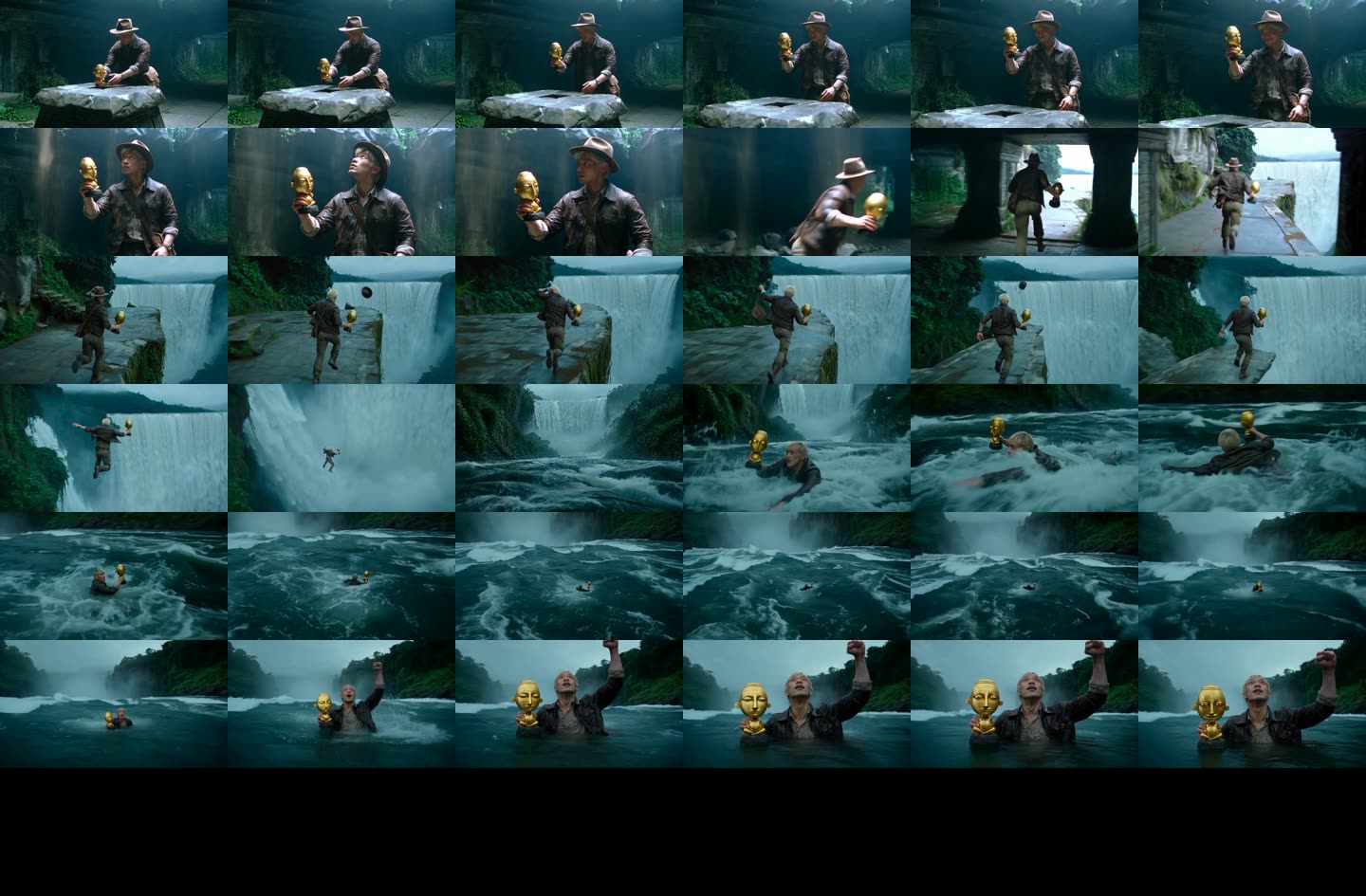
Figure: the final 36 s film, one frame per second.
This document tells the story of building a short AI-generated adventure film with a coding agent, from script to a five-clip stitch. It keeps the failures. Most of the hours went into fixing what the video models got wrong, not into getting them to produce clips.
How to read the evidence. Sections marked [reconstructed] come from the project's
HANDOFF.mdfiles, written by earlier sessions. The agent that wrote this document did not see those sessions. Everything else is written from the live transcript of the last session, in which the agent was Claude Sonnet 5.5 running in Claude Code.What is not published. The user's reference photos, the prompt that turned them into the hero, the user's name, e-mail address, account names and local paths are left out on purpose. The generated character sheets are shown in section 3.1b. Prompts for the shots are in
prompts/. They describe the hero only by costume. Some descriptive phrases were removed from these published copies, so they differ slightly from what was sent to the model.
1. The brief — what was actually being asked
A 45 s silent action-thriller in a Raiders-like adventure style. A fictional hero lifts a small gold idol from a temple altar. The temple shakes. He runs along a cliff, throws away his hat and satchel, and jumps into a waterfall. He surfaces in a river. A boat arrives late and pulls him aboard (twist 1). He throws the idol overboard. It sinks. He turns and the idol sits on the boat console behind him, smiling (twist 2). Cut to black.
How the agent read it:
- Every shot must be one continuous take. The user does not want visible cuts inside a shot.
- The idol is the villain, but it must stay a small, polished gold object. It wakes only in its face.
- The workflow is the course's: script, then reference assets (character sheets, props, locations), then one long structured prompt per shot, then assembly.
- Money is limited. The agent must show the price of every paid generation before running it.
Invisible constraints that shaped the output: the user's standing rules loaded into every session (plain-language reports, precise phrasing, "finish or say what you left", "smallest change that works", never kill processes by name), a "ponytail" lazy-developer mode that favours the shortest working diff, and a rule to show a price before a paid run. A hook also told the agent five times that the session was too long (section 8, item 18).
2. Starting state and what was reused
At the start of the last session the folder held: a script (script.md, v2, 7 shots), approved still images for the hero, idol, boat and three locations, three finished clips (shot 1, a bridge shot, shot 2), and a HANDOFF.md. The folder was not a git repository. It held a .env file with API keys, which is why this repository was built in a separate folder.
Reused, not re-derived:
HANDOFF.md— the resume record. It listed the accepted clips, the open tasks, the prices, the commands and the lessons. The agent worked from it with no extra exploration.shots/run_api.py— a 30-line runner for the Seedance 2.0 reference-to-video API, written in an earlier session. It readsprompt.txtandapi_ref_urls.json, submits, polls and downloads.shots/stitch/make2.sh— an ffmpeg concat script. It was extended intomake4.sh(nowtools/make_stitch.sh).- The prompt skeleton from the course: SCENE CONTEXT, ACTIVE REFERENCES, LOCATION MAP, FIRST FRAME / BLOCKING, FORMAT MODE, PERFORMANCE, PHYSICS, LIGHTING, AUDIO, STYLE, POSITIVE LOCKS.
Wall-clock of one API clip: 157 s (shot 3) and 203 s (shot 4 attempt 1) for 8 s of video. The CLI runs were not timed.
3. Timeline and sharp turns
3.1 Before the last session [reconstructed]
- The course. Ten lesson pages were read as text (the videos were not watched). The prompt-builder skill and the asset packs from the course were not downloaded. Prompts were written by hand in the course structure.
- Script v1 → v2. Version 1 had amber cracks, glowing effects and a giant stone guardian. The user rejected all three. Version 2 has a small, polished gold idol with no glow, no cracks and no giant. The guardian, the "hand cracks" prop and two idol designs were dropped.
- Assets. Images came from GPT Image 2.5 (0.5 credit each). Locations used Soul Location (0.12 credit each). A first river location did not match the cliff (the base of the waterfall and the river were different bodies of water). It was replaced by a river image generated from the cliff image, so the two share one body of water.
- Shot 1. Attempt 1 had two planned cuts. The detector found a hard cut at 6.54 s. The idol looked larger than palm size. The grin read as a smirk. Attempt 2 asked for one continuous take, a stronger grin and a smaller idol. It was accepted. Lesson recorded: write "one continuous take" and one camera move, never "CUT 1 / CUT 2", when the user wants no visible cut.
- Shot 2, first API run. Attempt 1 (7 s, API) was the first money spent on the API. It measured the real price at about $0.119 per second, not the $0.099 the pricing page suggested.
- The missing exit (sharp turn). The user noticed that no shot showed the hero leaving the temple. A 4 s bridge shot was added. The API version had the wrong hall (a green corridor with a grass floor), the hero looking back at the camera and the waterfall far away. A CLI version with a start frame (the last frame of shot 1) and an end frame (the first frame of shot 2) fixed it.
3.1b The character sheets
Seedance takes reference images. The course teaches "character sheets" so that the same person, costume and props appear in every shot. This project used three, all generated with GPT Image 2.5. The prompts pass them in a fixed order ("Image 1", "Image 2", ...) and say which panel to use.
The hero, dry (sheet A). Three panels: a headless front view, a headless back view, and a face close-up. The body panels carry the costume only (jacket, shirt, trousers, boots, satchel, watch). The close-up carries the face and the hat. Splitting the body from the face is a deliberate choice: the model reads the costume from the body panels and the identity from one face, so it has fewer places to drift. The prompts for shots 1, 2 and the bridge use this sheet. The prompts say "sheet background, panel layout and dividers NOT inherited", because a model otherwise copies the grey backdrop and the panel lines into the scene.
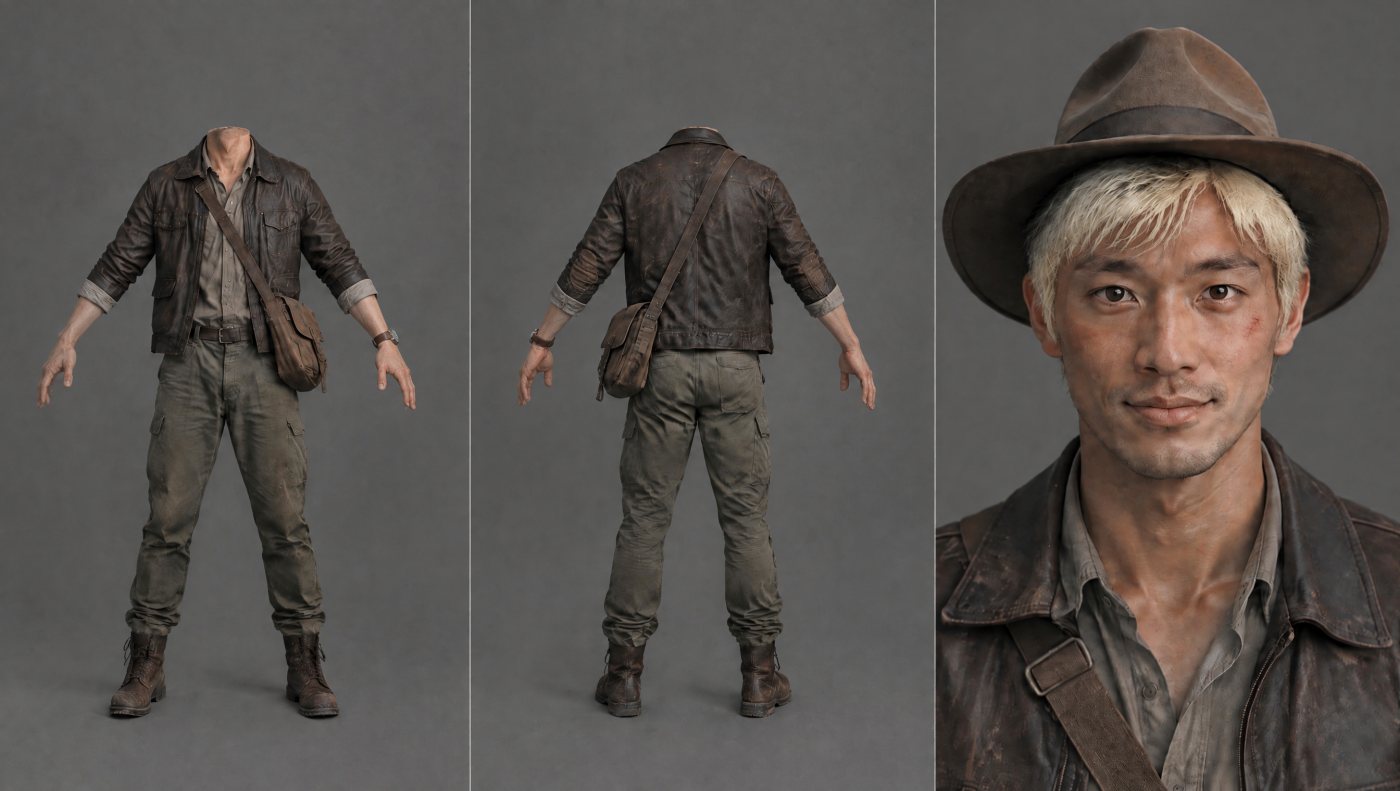
Figure: the dry hero sheet. Generated image; the original reference is not published.
The hero, wet and without the satchel (sheet C2). Shots 3 and 4 happen after the plunge. The first wet sheet (C) still showed the satchel in its body panels, although the hero throws the satchel away in shot 2. It was regenerated as C2 for 0.5 credit, with the satchel and its strap removed, the hat absent, a scratch on the left cheek and a soaked costume. The prompts say "He carries NOTHING except the idol."
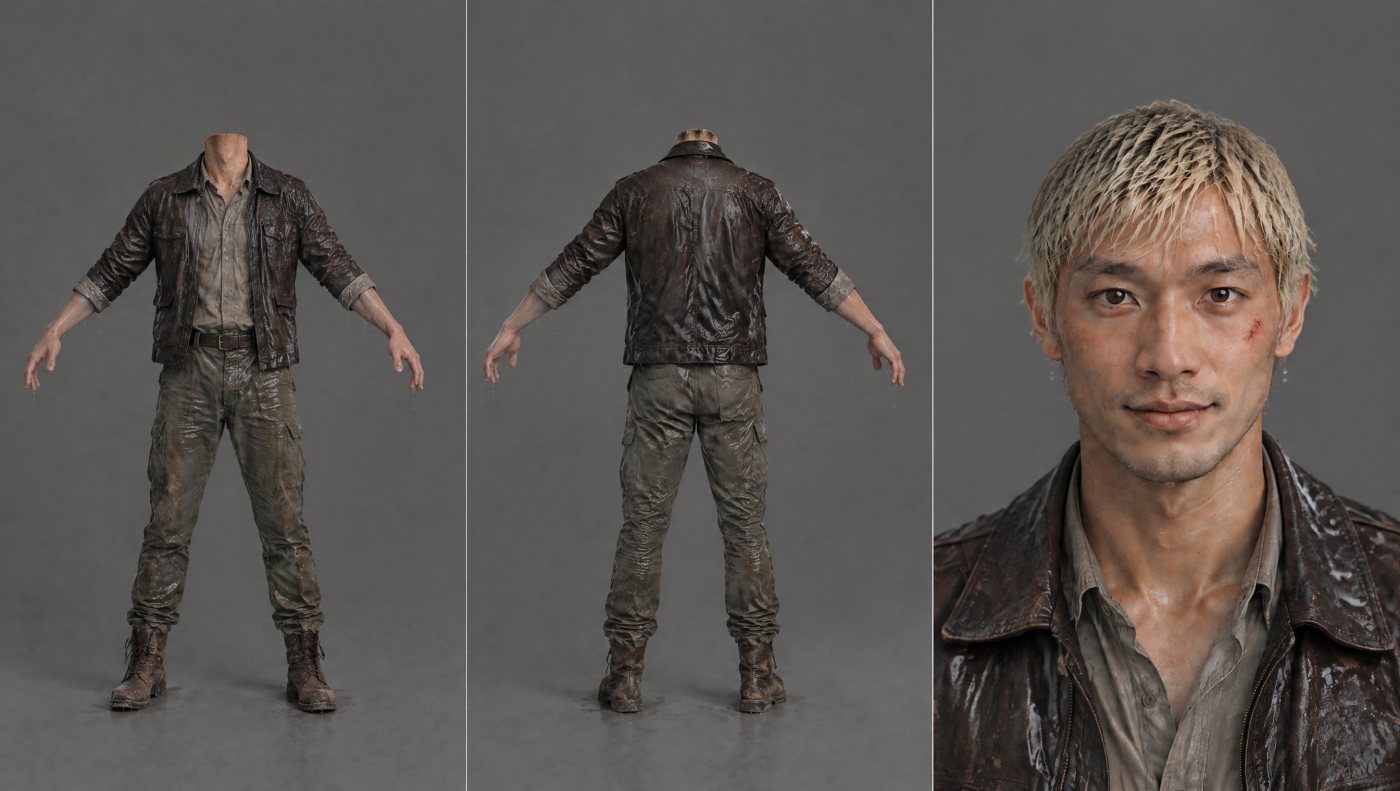
Figure: the wet hero sheet C2, used for shots 3 and 4.
The idol (three states). One sheet with three versions of the same object: asleep (eyes closed, closed mouth), waking (half-lidded eyes, a thin smile) and awake (wide eyes, a broad grin with teeth). The prompts name the panel to use at each moment. The awake panel was too friendly and too large-eyed for a villain, so the final shot 4 uses the centre panel for its end state and a pixel edit adds the teeth (section 4.4).
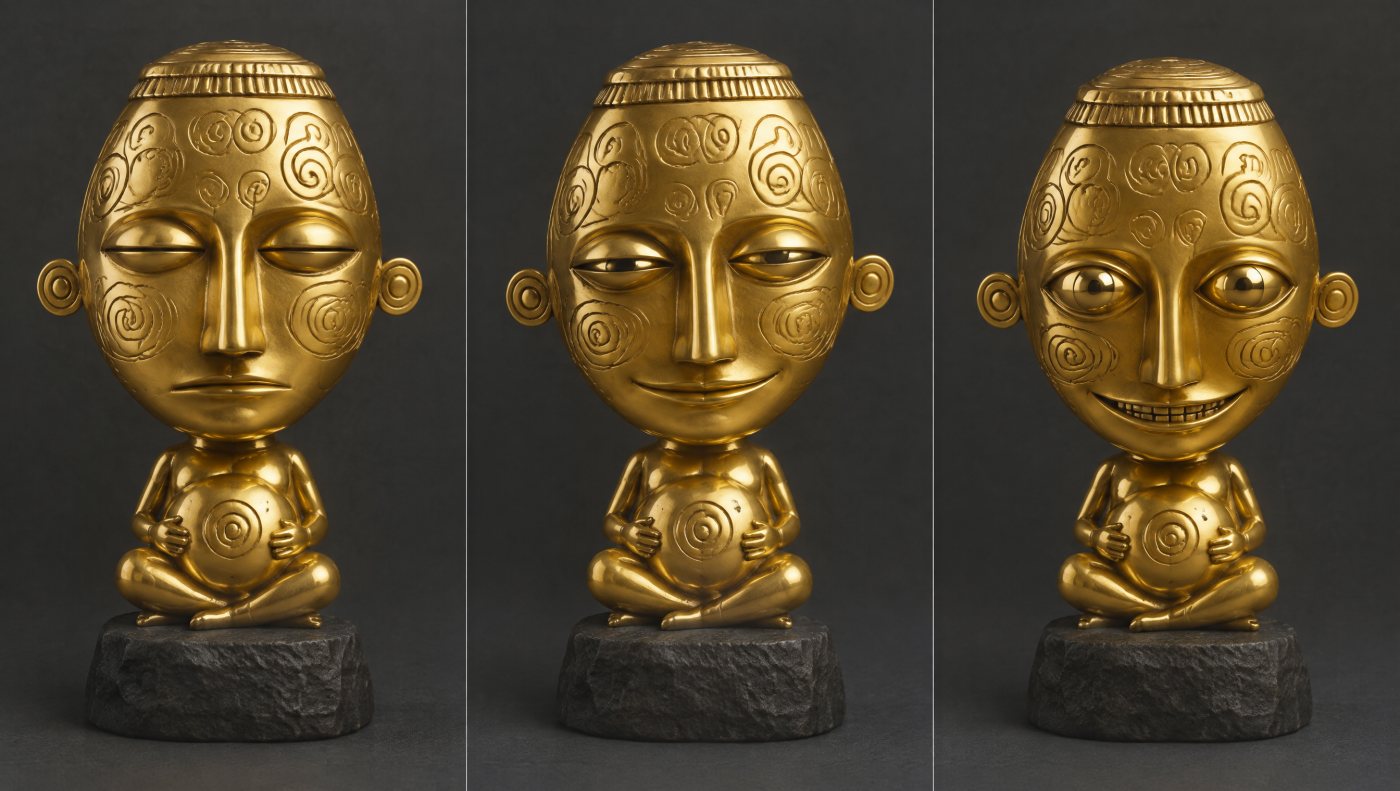
Figure: the idol sheet, left to right: asleep, waking, awake.
What the sheets did not prevent: the idol's scale drifted (section 8, item 17), and in shot 2 a copy of the idol appeared on the ledge in every attempt (section 4.1). A reference image tells the model what an object looks like. It does not tell the model how many of them to draw.
3.2 The last session, in order
- Shot 2 gold clean-up and the satchel path. The user found that in the cleaned shot 2 the satchel lands on the ledge at 4 s, slides left and stops at the left edge. They asked for it to fall into the waterfall. Section 4 explains why this was hard.
- Stitch D, and the jump at 12 s. After shot 2 was replaced, the agent rebuilt the stitch without checking the join. The user saw a jump. Section 8, item 5.
- Bridge remade a third time (12 credits), with the new shot 2 first frame as its end frame. The user's instruction: "approve but I don't want another cycle of cleaning up artifacts." The agent did no clean-up.
- Wet hero sheet without the satchel. Approved by the user.
- Shot 3 (he surfaces and swims, 8 s, API, $0.96). Run once. Accepted by implication when the user asked for a stitch.
- Shot 4, first plan: the boat. The agent wrote a 1,095-word prompt in which a boat bursts in from the left and a hand pulls the hero aboard. It priced it. The user changed their mind (sharp turn 1): no boat. A calm stretch of water. The hero catches his breath, raises his left fist, looks at the sky as if thanking God. At the moment he relaxes, the idol wakes behind a devilish grin. The boat asset was never used.
- Shot 4, attempt 1 (API, $0.96). The idol's grin was wide and friendly, the idol was as large as the hero's head, and the waterfall showed although the prompt said it must not.
- Shot 4, attempt 2 (CLI, 24 credits), with the last frame of shot 3 as the first frame. This needed the CLI, because the API reference route has no start-frame option. Subtler grin. The idol was still too big. No blinks.
- The blink request. While attempt 2 was running, the user asked for the idol to blink a couple of times, looking at the viewer, as if it shared a devilish secret the hero does not know. The agent added a blink beat to the prompt.
- The credit confusion (section 5). The CLI plan had 11.4 credits and a run needs 24. The user bought a 100-credit pack.
- Shot 4, attempt 3 (CLI, 24 credits, with blinks). Accepted.
- Teeth. The user: "the idol grin is not devilish and menacing enough. Can you just change the last few frames to bare the idol's teeth more. Do not change anything else." The agent did it as a pixel edit at zero cost (section 4.3). Accepted.
- Stitch H. Five final clips, 36.25 s. The user paused editing here and asked for this document.
4. The core problem: generated clips hallucinate, and the fixes are pixel surgery
Every clip came back with something wrong that the prompt had asked it not to do. A text-to-video model treats a prompt as a suggestion. Prompt changes moved the faults around; they did not remove them. The work that took the most time was deciding, per fault, whether to re-run (about $0.95 or 24 credits) or to paint it out (free, but costing the agent's time and tokens).
4.1 Shot 2: five attempts, one repeated hallucination [reconstructed]
Shot 2 is the 8 s run along the ledge and jump. The user wanted the hero to throw away his hat and satchel in one fluid, rehearsed motion with his left hand while the idol stays in his right.
| Attempt | What went wrong |
|---|---|
| 1 (7 s) | The satchel left his body without the strap passing over his head. The hat stayed on. |
| 2 | Order fixed (hat, strap over head, satchel, leap). But the waterfall became small and far on the left, and three small gold idol-like objects appeared on the ledge end. |
| 2b | Waterfall fixed. The strap lift was no longer clear. One gold object remained. The hat seemed to fly from his right hand. |
| 2c | Hat from the left hand. But the prompt sent the satchel to the right, the idol side, and the idol was thrown away together with the satchel. Rejected. |
| 2d | The user edited the prompt. The idol stays in the right hand. The waterfall is huge. A small gold stack remained on the ledge end, as in every attempt. |
The agent's cause for 2c: its own prompt sent the satchel to the same side as the idol. The cause of the gold stack is not known. It appeared in all five attempts, which suggests the references (the idol image was a reference) leaked a copy of the idol into the scene.
Five attempts cost about $3.8 of API money.
4.2 Removing the gold stack, twice [reconstructed]
Rather than pay for a sixth attempt, the stack was painted out of attempt 2d with OpenCV (Telea inpainting inside a tracked circle). Version 1 cleaned frames 123 to 140. The user then pointed at a gold object near 2 s. The cause was a second problem: the small gold copy sat on the ledge lip from frame 0 to 101, hid behind the real idol, and then grew into the stack. Version 2 cleaned frames 0 to 144, with a per-frame tracked circle and a yellowness test in Lab colour space, and a mask that protected the real idol. Known faults after version 2: a soft dark smudge on the ledge at frames about 125 to 139, and a slightly blurred left hand at frames 127 and 128.
Lesson: when the same hallucination appears in every attempt, stop re-rolling and fix it in pixels.
4.3 The satchel falls into the waterfall (last session, live transcript)
The user's complaint was precise: at 4 s the satchel lands at the edge of the cliff, drifts left, and ends at the left edge. The agent diagnosed it from frames: the hero throws with his left hand, the left side of the ledge is land, so the satchel can only land on stone. The waterfall is on the right. The agent offered two options: repaint for $0, or re-run for about $0.95 with a risk of new faults. The user chose the repaint.
The repaint went through several approaches. Four failed.
- Cut the satchel out in flight (frames 105 to 111) and repaint it falling off the ledge. The cut-out pulled in part of the idol and the hero's skin. The "idol protection" mask came from a gold-colour test and a convex hull. The test also matched his trousers, so the hull swallowed a trouser leg, and in some frames the idol's edge was repainted as water. The satchel is only about 30 px wide and already motion-blurred, so the painted copy looked pasted.
- Fill the ledge lump with a patch copied from elsewhere (template search), then with seamless cloning. Both left flat grey blocks. The fill sampled the wrong stone brightness, so it looked like a sticker.
- Fill with a blurred average of "stone-coloured" pixels. The mask missed the dark rim of the satchel, so a brown halo stayed.
- Fill with Telea inpainting inside a fixed ellipse. The ellipse covered the idol's dark base, so the base was smeared in frames 113 to 116.
What worked. Leave frames 0 to 112 untouched, so the satchel still lands at frame 112 as the model made it. Cut the sprite from the landed lump in frame 113. Make it bounce and tumble off the ledge corner. The path has eight points, rotates the sprite 28 degrees per frame and adds motion blur along the path. Remove the lump on the ledge with a colour mask (warm hues plus dark pixels, excluding the idol-base colour above the lump) and Telea inpainting. Remove the tan patch at the back edge of the ledge in frames 126 to 141, because it could be read as the satchel at the left edge.
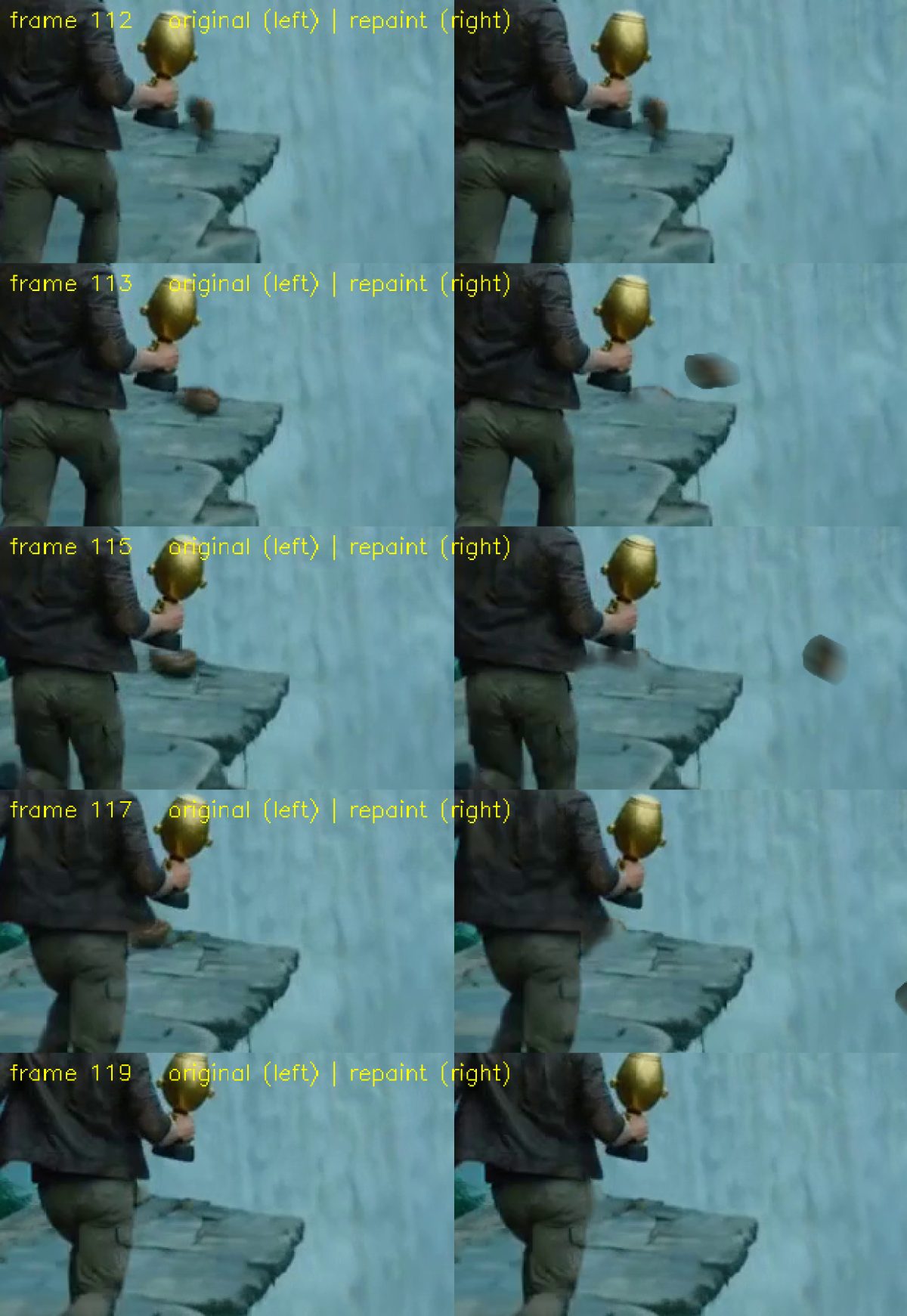
Figure: frames 112 to 119 of shot 2, original (left) and repaint (right).
Known faults the agent reported: the flying satchel is grey-tan and slightly boxy, faint smudges remain on the ledge, and frames 119 to 121 were not inspected closely because his legs hide the lump. The user accepted it.
Each failure was found by looking at frame sheets, not by a metric. Several image reads in the agent's tool returned "[media removed: request limit]", which forced the agent to re-render sheets and read them again. The whole repaint took a long series of tool calls.
4.4 The idol's teeth (last session)
The user wanted the idol to look more menacing in the last frames, with nothing else changed. A re-run could not guarantee that. The agent tracked the idol's face with an affine ECC alignment from the last frame backwards. It tried two edits.
- Paste the idol sheet's own toothy grin onto the face. Rejected by the agent before the user saw it. The sheet was lit brighter than the shot, the teeth interior came out blue, and the seamless clone left a halo.
- Open the idol's own jaw and raise the contrast of teeth against gaps. The jaw opens by up to 5 px, the contrast of tooth faces against gaps is raised by up to a factor of 1.9, and the effect eases in over frames 168 to 182 and holds to 192. The edit is blended through a feathered ellipse around the mouth.
Check: PSNR against the original is about 44 dB on untouched frames (the cost of the re-encode, libx264 crf 12) and about 41 dB on the last frames. The idol is about 100 px wide, so each tooth is a few pixels. The result reads as a dark jagged row. The agent told the user that this is subtle and offered to push it further. The user accepted. 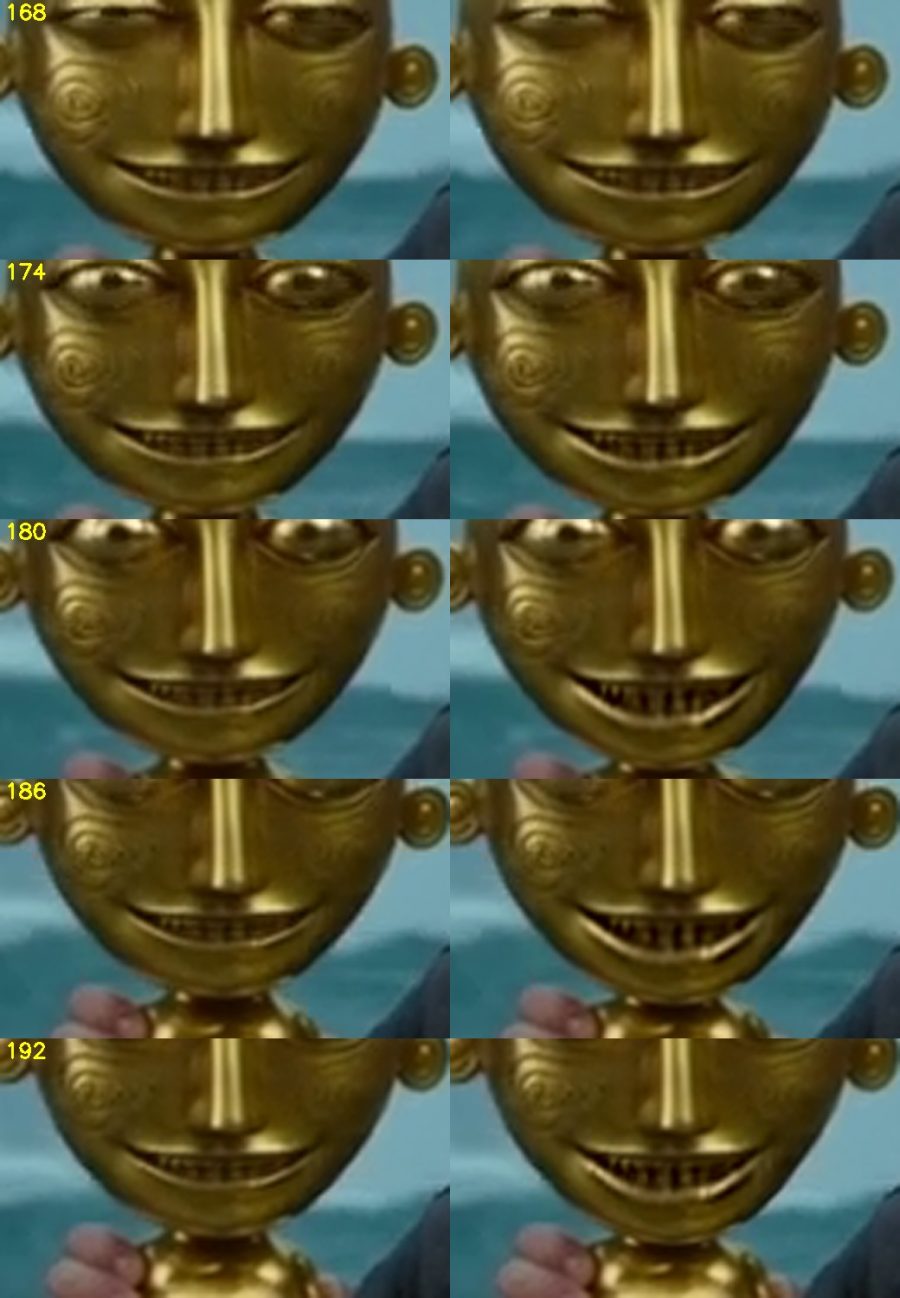
Figure: frames 168, 174, 180, 186 and 192, original (left) and edited (right).
4.5 Shot 4, attempt 1 versus attempt 3
Attempt 1 (API) had a broad friendly grin copied from the idol sheet's right panel. The prompt for attempt 3 said to use the centre panel (half-lidded eyes, thin smile) for the end state, to hold the idol "beside his chest at the same distance as his face", and to show no waterfall. 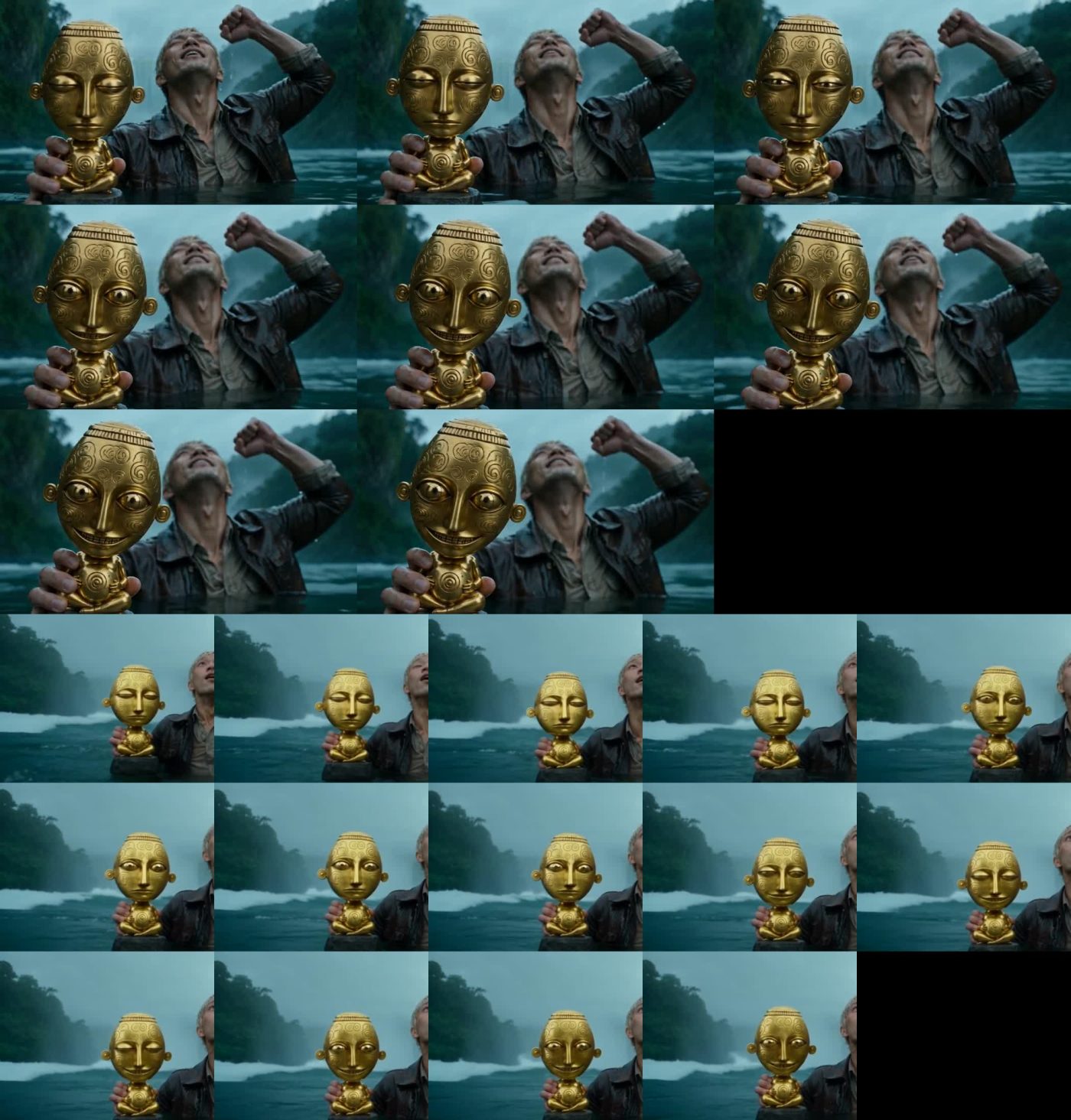
Figure: the idol waking, attempt 1 (top, wide eyes and a broad grin) and attempt 3 (bottom, narrow eyes and a thin smile). The idol still looks about as tall as his head in attempt 3. The user accepted that.
4.6 The bridge join
The first remade bridge ended on the first frame of the old shot 2. Section 8, item 5.

Figure: the bridge's last frame (left), the accepted shot 2's first frame (centre) and the old shot 2's first frame (right).
5. Money and credits: two wallets, and the $5 that went to the wrong one
Higgsfield sells the same video models through two doors with two separate balances. The agent knew this from the handoff. The user did not, and neither the agent nor the pricing pages made it obvious.
| Wallet | Used by | Where you add money |
|---|---|---|
| API balance (dollars) | the run_api.py script, calling api.higgsfield.ai |
the API console at open.higgsfield.ai |
| Plan credits | the higgsfield command-line tool (CLI) and the main site |
the main site's pricing page (a plan, or a "credits" pack) |
The sequence.
- After shot 3, the API balance read $2.56. Shot 3 cost about $0.96.
- For shot 4 the user wrote: "I just added USD 5." The balance page then read $6.61. The $5 went to the API balance. That was right for the API route.
- Shot 4 attempt 1 ran on the API. The balance fell to $5.65.
- The user then asked for the last frame of shot 3 as the first frame of shot 4. The API model the agent had been using (Seedance 2.0 reference-to-video) has no start-frame input. The CLI's Seedance 2.5 has one, together with reference images. The CLI draws on plan credits, which stood at 35.4. Attempt 2 cost 24, leaving 11.4.
- A retry with the blink request needed another 24 credits. The agent reported that the user was 12.6 credits short. The user answered "I already added $5" — the same $5 that sat in the API balance. The agent checked the API console (it still showed $5.65), explained the two wallets, and listed four options in a table.
- The user asked "why can't you use API?" The honest answer: the API can do a start frame (Seedance 2.5 image-to-video, about $1.40 for 8 s) or reference images (Seedance 2.0, about $0.96), but not both. The CLI route does both.
- The user opened the main site's pricing page and posted a screenshot of a 100-credit pack for $6.25 (a "26 percent off" label), asking whether it was enough. The agent answered yes and explained the page's fine print ("up to 4 Seedance 2.0 720p, 5 s generations") as the same amount of credit counted in a different video unit: 100 credits is about four 8 s clips at 480p on Seedance 2.5.
- After the purchase, the CLI reported 111.4 credits. Attempt 3 cost 24, leaving 87.4.
Totals (about; from the handoff and balance reads).
| Item | CLI credits | API dollars |
|---|---|---|
| Shot 1, attempts 1 and 2 (8 s each, Seedance 2.5) | 48 | |
| Bridge, API attempt (4 s, Seedance 2.0) | 0.48 | |
| Bridge, remake 1 (4 s, start and end frames) | 12 | |
| Shot 2, attempt 1 (7 s) | 0.83 | |
| Shot 2, attempts 2, 2b, 2c, 2d (8 s each) | about 3.83 | |
| Wet hero sheet without the satchel | 0.5 | |
| Bridge, remake 2 (for the new shot 2) | 12 | |
| Shot 3 (8 s) | 0.96 | |
| Shot 4, attempt 1 (API, 8 s) | 0.96 | |
| Shot 4, attempts 2 and 3 (CLI, 8 s each) | 48 | |
| Video total since shot 1 (not counting the 0.5-credit image) | 120 | about 7.06 |
Money put in during the last session: $5 to the API balance and $6.25 for 100 plan credits. Balances at the end: 87.4 plan credits and $5.65 API. The amount the user first funded the account with is not recorded in the handoff files; the API balance was $7.70 when the first handoff was written.
Price rules learned: the CLI charges 3 credits per second of Seedance 2.5 at 480p. The API charged about $0.119 to $0.12 per second for Seedance 2.0 at 480p even with image references, and the pricing page's "max discount" rate did not apply. The agent read the real balance from the API console before each run after shot 3, because its estimates drifted by a few cents (est. $2.59, real $2.56).
Rule: before a run, name the wallet. A top-up in one wallet does not pay for a run in the other.
6. Models and tools, step by step
| Step | Model or tool | Notes |
|---|---|---|
| Planning, prompts, frame review, repaint code, this document | Claude Sonnet 5.5 in Claude Code (last session). The model of earlier sessions is not recorded in the handoff files. | No subagents. No advisor calls. No workflow tool. The work was done inline. |
| Hero sheets, idol sheet, boat, wet sheets | GPT Image 2.5 (CLI gpt_image_2_5) |
0.5 credit each, 2K, 16:9 |
| Locations | Soul Location (CLI soul_location), per the handoff |
0.12 credit each |
| Shot 1, attempts 1 and 2 | Seedance 2.5, CLI, omni_reference mode |
3 reference images; 8 s; 480p |
| Bridge, first try | Seedance 2.0 reference-to-video, API | 4 reference images |
| Bridge, remakes 1 and 2 | Seedance 2.5, CLI, with --start-image and --end-image |
plus 2 reference images |
| Shot 2, five attempts | Seedance 2.0 reference-to-video, API | 3 reference images |
| Shot 3 | Seedance 2.0 reference-to-video, API | 3 reference images |
| Shot 4, attempt 1 | Seedance 2.0 reference-to-video, API | 3 reference images |
| Shot 4, attempts 2 and 3 | Seedance 2.5, CLI, --start-image plus 2 references |
start image = last frame of shot 3 |
| Satchel repaint, face tracking, teeth edit | Python 3.13, OpenCV 4.13.0, NumPy 2.2.6 | scripts in tools/ |
| Frame extraction, cut detection, stitching, encoding | ffmpeg 7.1.1 | select='gt(scene,0.15)' for cuts |
| Reading the API balance | the in-app browser of Claude Code, on the API console | the user was already logged in |
Sound: all audio in the film is generated by Seedance (generate_audio: true). No music or mixing was done. The agent never heard the audio. Two models are in the film (Seedance 2.5 for shot 1, the bridge and shot 4; Seedance 2.0 for shot 2 and shot 3). The colour match at each join was checked by eye on frames, not by a metric.
Architecture: prompt file and reference URLs → a runner (tools/run_api.py for the API, higgsfield generate create for the CLI) → a result URL → a download → ffprobe and a frame sheet → the user's verdict → a copy into shots/final/ → tools/make_stitch.sh → the film.
7. Decisions, with the alternatives that lost
- Repaint the satchel instead of re-running shot 2 (user chose). Lost: re-run at about $0.95, which risked a sixth set of new faults. The repaint is free but cost the agent a long series of tool calls.
- Do not clean artifacts in the new bridge (user instruction). Lost: another clean-up pass. The bridge's fast turn looks rubbery. That stands.
- CLI for shot 4's retry, to keep the start frame and the references. Lost: API image-to-video at about $1.40 (no references, face may drift); API reference-to-video at about $0.96 (no start frame, hard cut at the join). The user decided after buying credits.
- Edit the teeth in pixels instead of re-running shot 4 (agent proposed, user accepted). A re-run could change the face, the blinks and the timing, which the user had just accepted.
- Write the prompt for the idol's final state from the sheet's centre panel, not the right panel, because the right panel's grin is friendly.
- One continuous take per shot. Lost: shot-reverse-shot coverage, which the models cannot keep consistent.
- Keep the boat asset unused rather than force a boat into the story after the user changed shot 4.
- 480p only. Lost: 720p for sharper detail. The budget allowed no retries at 720p.
- Publish only the final stitch, not the individual clips, to keep the repository small (about 11 MB).
- Descoped: music, sound mixing, the ending (idol thrown away, sinking, appearing on the console, cut to black), colour matching between the two models, 720p or 1080p renders, a Premiere Pro edit.
First instincts the agent overrode: it first planned to re-run the satchel throw; it first pasted the sheet's grin onto the idol; it first proposed the API for the blink retry because it had the money. Each was dropped after a look at the evidence.
8. What went wrong, and the fixes
- Idol hull swallowed his trousers. The idol mask used a gold-colour test and a convex hull. Trousers matched the test. Fix: seed the hull from the largest connected component only and tighten hue, saturation and value.
- "Telea" fill left a flat grey block on the ledge. Fix: build the mask from warm and dark pixels, exclude only the idol-base colour above the lump.
- A Python heredoc broke on a quote. Error:
/usr/bin/bash: -c: line 47: unexpected EOF while looking for matching''`. Nothing ran. The agent had embedded a long prompt with apostrophes in a shell heredoc. Fix: write prompts with the file tool, not the shell. - A frame extraction wrote no file.
ffmpeg -sseof -0.05 ... -frames:v 1produced nothing and the next step failed withcan't open/read file: check file path/integrity. Fix:-sseof -0.1 ... -update 1. - The jump at 12 s (the main process failure). After shot 2 was replaced, the agent rebuilt the stitch and sent it without checking the join. The user wrote "there is a jump/cut at 11 sec. I thought we removed it already." Scene detection found the one hard cut at 12.125 s. The bridge had been generated to end on the first frame of the old shot 2. The new shot 2 opens with a different camera (a taller jungle wall, a larger ledge). Frame similarity between the bridge's last frame and shot 2's first frame fell from 22.3 dB to 15.4 dB. Fix: a third bridge, 12 credits, similarity 19.6 dB, no hard cut at the standard threshold. Rule: when you replace a clip, re-check both joins before you send the stitch. The user said "11 s"; the cut was at 12.1 s. The agent reported the difference instead of silently correcting it.
make2.shstill pointed at old files. The stitch script had paths to the first accepted shot 2 and to a bridge that had been replaced. Fix: point it atshots/final/, and later extend it to five clips.- Upload failure. The first send of the four-clip stitch (7.6 MiB) failed with "upload failed: network error (timeout of 30000ms exceeded)". The file was visible on the desktop only. The agent told the user.
- Price shown inside a tool log, not as a message. The user wrote "Show me the price, then run it at 8s." The agent ran the CLI price check and the run in the same turn. The 24-credit price appeared in a tool result and in the final report, but not as a message before the run. The user had pre-authorised the run, so no rule was broken, but the user asked for a pause the agent did not make. It cost nothing extra, because the price matched.
- A mid-run request arrived too late. The user's blink request landed while shot 4 attempt 2 was running. The clip, with no blinks, had already cost 24 credits. The agent sent it, said so, and wrote the new prompt.
- The balance confusion (section 5) cost two exchanges and a browser session.
- Frames "media removed: request limit". The image-reading tool returned that text during the satchel work, so several frame sheets were not visible. The agent re-rendered smaller sheets.
- Wrong estimate of the balance. The agent estimated $2.59 for the API; the real figure was $2.56. Read the balance before the run, not after.
- A hallucinated hand (reconstructed). In shot 2 attempt 2b, the hat seemed to fly from the hero's right hand. The user noticed it. The handoff confirms it was true: the hat was hidden for about a second and then appeared.
- The gold stack reappeared in every shot-2 attempt. Fix: pixel removal (section 4.2).
- The first pasted teeth failed (section 4.4).
- The pricing page did not load a balance. The agent tried a screenshot and a text read before reading the balance with a short script.
- The model could not keep the idol's scale. In shot 1, attempt 1, it was too large; in shot 4, attempts 1 to 3 it stayed as large as the hero's head. This was never fixed. It was accepted.
- The session ran far too long. A hook told the agent five times, at reported sizes between about 360k and 446k context tokens, to write a handoff and clear. The agent surfaced the note each time and kept working, because the user kept issuing tasks.
HANDOFF.mdwas appended after each milestone as insurance. The cost of each turn grew accordingly. - Fragile: the frame numbers in the repaint scripts. The satchel path, the lump coordinates and the face anchors are hard-coded for this one clip at 864x496. They will not transfer.
-
Fragile: the fix for shot 3 → 4 continuity. Shot 4's first frame is close to, not identical with, shot 3's last frame. The join looked continuous in the agent's frame check. Whether it plays smoothly depends on the user's eyes.
-
The first public commit carried a personal e-mail address. The agent ran
git commitin a fresh repository. The global git configuration on the machine held the user's personal e-mail, so the commit author and committer were that address. The agent pushed first and read the identity afterwards. It then amended the commit to GitHub's no-reply address and force-pushed (the branch held only that commit). The old commit stayed fetchable by its SHA through the GitHub API, because GitHub keeps unreachable commits until garbage collection. The push may also appear in the public events feed. The repository cannot be fully cleaned without GitHub's help or a delete-and-recreate, and deleting needs a token scope the CLI did not have. Rule: set a no-replyuser.emailin the repository before the first commit, and readgit log -1before the first push.
9. Human-in-the-loop moments
Every verdict in this project was the user's. The agent never heard the audio or watched motion; it saw 2 fps frame sheets, 4 fps close crops and numeric checks.
- Approved prices and routes before paid runs (shot 3, shot 4, bridge remake 2).
- Rejected or accepted every clip, usually with a precise fault ("the hat flew from the right hand", "the idol was thrown with the satchel", "the satchel lands on the ledge").
- Changed the story twice mid-flight: the extra bridge shot, and shot 4 from a boat rescue to an idol that wakes.
- Edited a shot 2 prompt by hand (attempt 2d).
- Added the blink request mid-run.
- Bought credits: $5 to the API balance, and a $6.25 pack of 100 plan credits. The agent cannot pay.
- Stayed logged in to the API console, so the agent could read the balance in the browser pane.
- Gave the instruction to publish: create the repository, push it, and make the film a page.
10. Verification
What was checked, and how.
- Size and length:
ffprobe. The final stitch is 854x480, 36.25 s, 24 fps, with an AAC audio stream of 36.18 s. - Cuts:
ffmpegscene-change detection at 0.15 and 0.30. The final stitch has one hard cut, at 20.17 s (shot 2 to shot 3, the plunge into the pool). It is intended. At 0.10 the detector flags many frames in the river shots; that is water motion. - Joins: frame pairs and PSNR for the bridge.
- Identity, costume, hands, idol size and side, waterfall in frame: by eye on frame sheets.
- Edits: before-and-after frame strips; PSNR between the original and the edited clip.
- Balances: read from
higgsfield account statusand from the API console after each paid run.
What was not verified: the audio of any clip, the motion of any clip, the colour match between Seedance 2.0 and 2.5 clips, whether the blink count reads as two to a viewer (the agent counted eye states at 4 fps), and the film on devices other than the user's desktop.
11. Unfinished business
- The ending. The original script's shots 5 to 7 (the idol thrown overboard, sinking, then sitting on the boat console behind the hero) are not made. Shot 4 now holds the "idol wakes" moment, so the old plan overlaps. The user has not said how the film ends. It currently ends on the idol's grin at 36.25 s.
- Runtime. 36.25 s against a 45 s target.
- The idol's scale is larger than the prompts asked in the shot 4 clips.
- Audio. No music, no sound design, no mix.
- Resolution. 480p only.
- Unused assets. The boat image and the original-plan shot 5 to 7 materials.
- Known faults left in the film. The grey, boxy satchel in shot 2; soft smudges on the ledge in shot 2 (frames about 113 to 133); a rubbery turn in the bridge; the idol's teeth read as a dark row, not as separate teeth.
The deliverable stands without these. It is a complete 36 s sequence with a beginning, a chase and a reveal.
12. Knowledge captured
HANDOFF.md(not published; contains account details): updated after every milestone, with commands, prices, balances and the faults of every clip.prompts/: every prompt version that produced a final or a notable failed clip.tools/: the runner, the stitch script and the three repaint and edit scripts.- This document and
docs/journey.html.
One-liners learned in this project:
- Write "one continuous take", never "CUT 1 / CUT 2", when you want no visible cut.
- When the same hallucination appears in every attempt, stop re-rolling and paint it out.
- Before a paid run, name the wallet.
- When you replace a clip, re-check both joins before you send the stitch.
- A prompt that lists what must not appear also names it. A model may then draw it. Test with a short run first.
- A mask built from a colour test grabs every object of that colour.
- Read the real balance before the run, not after.
- Check the commit identity before the first push.
- Design the artifact out of the story: a prop that must be handed off or thrown costs more than the story gains.
- Cap attempts at two, then change the beat.
13. Bitter lessons, and the playbook for the next shots
About half of the credits and about three quarters of the API money bought clips that are not in the film. This section adds that up, lists every fix, and turns the failures into rules for the remaining shots.
13.1 What the artifacts cost
Spend on video since shot 1, from the balance reads (section 5). A "kept" clip is one that is in the final film.
| CLI credits | API dollars | |
|---|---|---|
| Total video spend | 120 | about 7.06 |
| Kept clips (shot 1 attempt 2, bridge remake 2, shot 4 attempt 3 on the CLI; shot 2 attempt 2d and shot 3 on the API) | 60 | about 1.91 |
| Spent on clips that were not kept | 60 (50 percent) | about 5.15 (73 percent) |
At the price of the 100-credit pack ($6.25, so $0.0625 per credit), the total is about $14.5 and the part not kept is about $8.9, which is 61 percent. The plan credits were not bought at that rate, so read the 61 percent as an estimate. The agent's time is not in these numbers. The repaints and the teeth edit cost $0 but took a long series of tool calls (sections 4.2 to 4.4).
13.2 Every fix, in one table
| # | Artifact | Where | What was tried | Cost | Result |
|---|---|---|---|---|---|
| 1 | Extra gold idols at the cliff edge (one to three small copies, one growing into a stack) | shot 2, all five attempts | Re-roll with a stronger lock ("no other gold"); then OpenCV inpainting, twice (v1 cleaned part of the clip, v2 all 145 frames) | four re-rolls (about $3.8) plus two repaints | Gone, with a dark smudge and a blurred hand left behind |
| 2 | The hero cannot lift the satchel strap over his head and dispose of the satchel | shot 2, all attempts | Prompt rewritten as steps: hat off, strap over head with the left hand, dump the satchel, leap | the same re-rolls | Not solved. The final clip shows a plausible version. The user still sees it as wrong. |
| 3 | The satchel lands on the ledge, slides along it and stops at the left edge | shot 2, attempt 2d | Four repaint approaches failed; the fifth bounces the satchel off the ledge into the waterfall | $0, a long series of tool calls | Accepted, with a grey boxy satchel and faint smudges |
| 4 | Hand confusion: the hat flew from the wrong hand; the satchel went toward the idol hand; the idol was thrown away with the satchel | shot 2, attempts 2b and 2c | The user edited the prompt (2d); the left and right sides were rewritten | two re-rolls (about $1.9) | Fixed in 2d |
| 5 | Wrong hall, hero looks back at the camera, waterfall far away | bridge, API attempt | Rebuilt on the CLI with a start frame and an end frame | $0.48, then 12 credits | Fixed. Then a replaced shot 2 broke the join and a third bridge cost 12 more credits. |
| 6 | Two cuts in a shot that must be one take | shot 1, attempt 1 | Prompt rewritten as one continuous take | 24 credits | Fixed |
| 7 | Friendly grin, idol as large as the hero's head, waterfall in frame | shot 4, attempt 1 | Centre panel of the idol sheet for the end state, a start frame, size and "no waterfall" locks | $0.96 | Grin and waterfall fixed. The idol is still too large. |
| 8 | Teeth not menacing enough | shot 4, attempt 3 | Pixel edit of the mouth (section 4.4) | $0 | Accepted |
| 9 | No blinks (the request came after the run started) | shot 4, attempt 2 | Blink beat added to the prompt, re-run | 24 credits | Fixed in attempt 3 |
13.3 What the artifacts have in common
These are the agent's readings of the evidence. They are not proven. Nobody ran a controlled test.
- The model fails at contact choreography. Items 2, 3 and 4 are all a hand and an object: a strap over a head, a throw, a hand-off. Items 1 and 7 are the idol's size and number. Running, swimming, looking up and an expression change worked on the first or second try (shot 3 took one attempt). The hardest beat in the film, the strap, was a body and an object in contact.
- Long single takes multiply the failures. Shot 2 had five beats in 8 s (run, hat, strap, satchel, leap), and each beat could break. The "one continuous take, no visible cut" rule was the user's. It is the main reason a re-roll costs a whole shot.
- Every reference image is a possible source of a duplicate. The idol sheet went into shot 2 although the idol is a small object seen from behind. A copy of the idol appeared on the ledge in all five attempts. The cause was not tested. A reference image says what an object looks like. It does not say how many to draw.
- Left and right are unreliable when the camera is behind the hero. The prompts used the hero's left and right. The model's mistakes in 2b and 2c are the wrong side in screen terms.
- A list of things that must not appear may name them. "No waterfall" did not prevent the waterfall in shot 4 attempt 1. It worked in attempt 3, where a start frame was also given. The agent suspects the start frame did the work.
- A fault that touches the action cannot be painted out. A static copy of the idol on a ledge could be painted out. A satchel that must fall, bounce and leave the frame took five approaches. A strap that must pass over a head cannot be painted at all.
- Changes of mind after a run are the most expensive kind. The blink request arrived mid-run. The boat shot was written, priced and dropped. A replaced shot 2 invalidated the bridge.
- Prompt length did not buy control. The prompts grew from about 700 words to 1,365. The longest prompt (shot 4 attempt 3) worked, but the idol was still the wrong size, so the length did not fix the size.
13.4 The playbook for shots 5 to 7
The rules below are ordered by how much money each would have saved.
- Design the artifacts out of the story. Do not ask for a hand-off, a strap, a throw or a catch. The hero keeps the idol in one hand for the whole film. If an object must leave, it leaves the frame at the moment it leaves the hand (up, out of frame, or toward the camera), so the model never draws it landing. The satchel and the hat are gone. Do not bring new props.
- One beat per shot, 4 to 6 s. Cut between beats on motion. The user's "one continuous take" rule means no cut inside a beat. A cut between beats hides a continuity error for free. This is the largest saving: a faulty beat costs 12 credits (4 s) instead of 24 (8 s), and one bad beat does not sink the shot.
- Approve stills before video. A still costs 0.5 credit (GPT Image 2.5). A 4 s video costs 12 credits. Make the first and last frame of each shot as stills, approve them, and then generate the video between them with
--start-imageand--end-imageon the CLI. This is how the second and third bridges and shot 4 attempt 3 were made, and their joins held up in the user's review. - Chain with start frames. Every shot starts on the last frame of the previous shot. Shot 4 did this and has a continuous join. This also removes the "check the join" problem when a shot is replaced: replace a shot, and regenerate only its successor's start.
- Cut the references to the minimum. Start frame, plus one still of the face if the face is not in the start frame. Do not pass a three-state idol sheet. Pass one idol still in the state the shot needs (asleep, waking or awake). See 13.5.
- Short prompts, one beat, sides in screen terms. Aim for 250 to 400 words. Write "on the left of the frame", not "his left hand". Write "exactly one idol, in his hand" once instead of repeating the idol's description in every section.
- Cap the attempts at two. If the second attempt still fails, change the beat or cut away from it. Do not run a third time. Shot 2 had five attempts and two repairs.
- Triage a fault before paying. Structural fault (the action is wrong): rewrite the beat or cut away. Small static background object: paint it out only if it takes under an hour of the agent's time. Moving object that interacts with the hero: re-roll once, then cut away.
- Probe cheaply. A 4 s probe at 480p on the API costs about $0.48. Use it to test the one risky beat. It cannot test an 8 s action, so it is only worth running on a beat that is short.
- Freeze the beat list before the run. The user signs off on the beats of a shot, the first frame and the last frame, then the agent runs. Requests such as "add blinks" come before the run, not during it.
- Re-check joins whenever a neighbour changes. Replace a clip, then regenerate or re-check both joins before sending a stitch.
- Name the wallet (section 5) and read the balance before the run.
- A frame checklist for every clip, before the user sees it: how many idols; which hand holds the idol; which props are present; is the waterfall in frame; do the first and last frames match their neighbours. The agent already did most of this by eye. Doing it first would have caught items 1 and 4 one attempt earlier.
13.5 Do we need the character sheet?
Short answer: a clean face reference helps, but the multi-panel sheets are not worth their side effects, and the idol sheet probably did harm.
The reasoning. This is not a 3D or game project, so nothing is rigged or modelled. A video model does not read a "sheet" as a model. It reads it as an image that conditions the video. So the real question is what conditioning is cheapest and safest.
- What the hero sheets bought. The face, hat, jacket and trousers stayed recognisable in shots 1 to 4, and the user accepted the identity in every shot. The cost was about 0.5 credit per sheet. That is the cheapest thing in the project. Two things worked against it. The first wet sheet still showed the satchel in its body panels, so it had to be regenerated. And every prompt needed locks ("sheet background, panel layout and dividers NOT inherited") so that the model did not copy the grey backdrop and panel lines.
- What the start frame does instead. When the start frame shows the hero's face and costume, the first image already carries the identity. The bridge starts on the last frame of shot 1 and the identity held. In shot 4 the start frame showed only a tiny figure in the rapids, so the face came from the wet sheet, and there the sheet did real work. So the sheet matters when a shot starts without a clear view of the face, for example the first shot of a new scene.
- The idol sheet is the doubtful one. It shows three states side by side. In shot 4 attempt 1 the model took the awake panel's wide eyes and broad grin, which is the wrong villain. In shot 2 a copy of the idol appeared at the ledge in every attempt, although the idol was a small object seen from behind. The agent suspects that the reference caused the duplicates. This was not tested. A single-state still per shot would not carry that risk.
- Recommendation. Keep one clean hero still (face, hat or no hat, matching the shot) as a reference when the start frame does not show the face. Drop the multi-panel hero sheets for new shots. Replace the idol sheet with one still per state. Test the suspicion once and cheaply: run the same 4 s beat with and without the idol sheet, about $0.96 on the API.
13.6 Questions for the user
- The ending. The old shots 5 to 7 (boat, idol thrown, sinking, console) no longer fit. What happens after the idol grins? A shorter ending with one beat per shot is the cheapest.
- Relax the take rule? Allow cuts between beats (but not inside a beat)? This is the biggest saving.
- Run the with-and-without idol-sheet test? About $0.96.
- Stills first? Approve a first and last frame as images before each video, at 0.5 credit per image.
14. Where things stand
- The film: https://az9713.github.io/raider-of-lost-art/
- The repository: https://github.com/az9713/raider-of-lost-art
- Credits: 87.4 plan credits (about 29 s of Seedance 2.5 at 480p) and $5.65 of API balance (about 47 s of Seedance 2.0 at 480p). The plan credits from the pack are valid for 90 days.
- The user paused editing.
Options for the next session, not promises:
- Describe the ending and write shots 5 to 7 (about 9 s of the 45 s target remain; about 16 s if the old three-shot ending is kept).
- Accept the 36 s film as the final cut and add sound design.
- Re-run shot 4 at 720p for a sharper idol, if credits allow.
- Replace the satchel sprite with a generated satchel image for a cleaner fall in shot 2.